
Subsidy vs. Investment in Future Revenue
The difference between a Renewable Energy Subsidy and a Fossil Fuel Investment is that
the Government (Taxpayer) receives Royalties throughout the life of the Fossil Fuel producer.
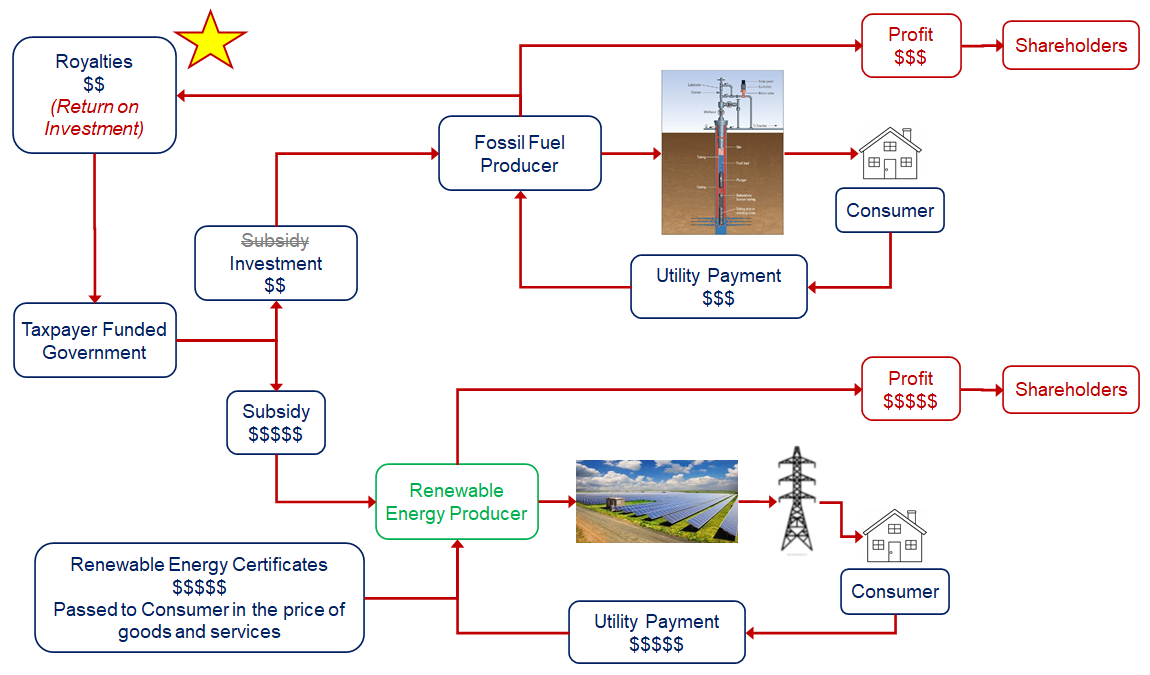
Subsidies to Renewable Energy Producers Increase Profits Only and do not benefit the taxpayer in any way.
- The Renewable Energy subsidies are CASH payments to offset capital and construction costs intended to make the projects economic. Producers would never build a facility based on the same economics as Fossil Fuels. Click Here for discussion on LCOE.
- Once paid, the taxpayer never receives any direct benefit.
- Utility payments from consumers go back to the producer.
- The producer is permitted to sell Renewable Energy Certificates (RECs). This allows companies to pay to meet GHG Intensity Targets without actually having to cut GHG emissions. REC payments are ultimately passed down to the consumer in the cost of goods and services. In effect, the RE producer is getting paid twice for each MW of power generated. There are no penalties for when electricity is not generated (i.e. at night or when the wind fails to blow). RECs and Carbon Credits is best described as "A Lack of Delivery of an Invisible Product to No One".
- All earnings are put directly toward profit benefitting the shareholders and NOT the Taxpayer!
What are often referred to as "Subsidies to Fossil Fuel" are actually Investments by the Taxpayer toward Future Revenue.
- The Fossil Fuel producer does not receive any CASH payments.
- The government supports the Fossil Fuel Producer through:
- Royalty Credits
- Tax Incentives
- Research Funding
- Occasional GHG Emission Reduction Assistance
- Utility payments by consumers go to the producer.
- Royalties are paid on the volume/quantity produced without regard to what the producer receives for the energy.
- The Taxpayer benefits from Royalties for the life of the project. Total Royalties exceed the original investment by Many, Many Times.
- The FF producer still makes a profit after the royalties are paid, just not the windfall profits like the Renewables producer.
- Due to higher margins/profits of Renewable Energy producers, they may pay a few more corporate tax dollars than Fossil Fuel producers. However, this is insignificant compared to the Royalties Received.
Putting Things in Perspective Source
- Government subsidies for private sector businesses and government business enterprises totaled $131.8 billion from 2010 to 2016, or $18.8 billion per year.
- The top three recipients of government subsidies were urban transit systems ($27.8 billion), crop production ($12.8 billion) and the motion picture industry ($12.6 billion). The least subsidized industries were the aerospace sector ($0.7 billion) and the automotive sector $(0.6 billion) though those latter figures do not account for the 2009 federal-Ontario $13.7 billion automotive sector bailout as that disbursement falls outside of the 2010-2016 “window” of comparable data provided by Statistics Canada. There are other limitations to the Statistics Canada data as outlined in the Source document.
- Looking at subsidies by sector in-province, (with payments from federal, provincial and local governments), subsidies for the oil and gas industry in Alberta amounted to $1.7 billion between 2010 and 2016 inclusive. This is lower than the subsidies received by the motion picture and video production industries in Quebec ($3.1 billion) and British Columbia ($3.2 billion), and the electricity generation sector in Ontario ($6.2 billion).
- The promised $1.7 billion subsidy to the oil and gas industry for inactive and orphan well clean-up is not yet captured in Statistics Canada data.
- The most comprehensive analyses of the claims of annual multi-billion-dollar subsidies to the oil and gas sector over the past decade have come from economists Kenneth McKenzie, Jack Mintz and Ross McKitrick. In 2017, Prof. McKitrick noted the following, which sums up the problem with assumptions behind multi-billion-dollar figures:
“For the purpose of determining the actual size of subsidies to fossil fuels it would appear that conventional subsidies, that is actual payments to consumers and firms, are at the low end of the range of past estimates and are only a small percentage of the large numbers that have sometimes been put forward. To the extent we include indirect or notional concepts the numbers get dramatically higher but they also become meaningless and potentially misleading.”