
Wind & Solar and the "Rule of Diminishing Returns"
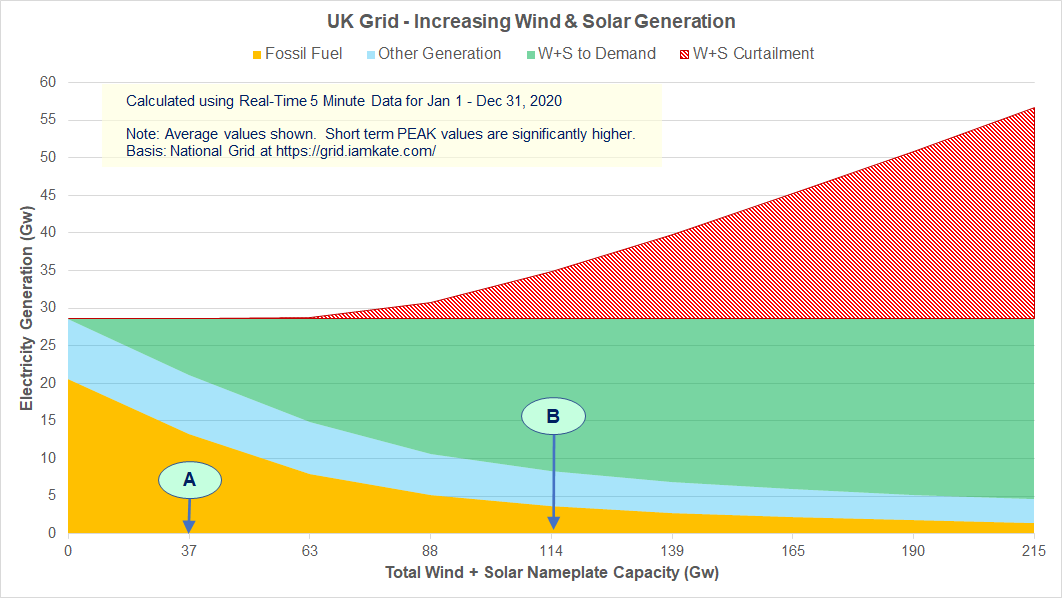
Each successive increase in Wind or Solar Capacity will result in a progressively lower displacement of Fossil Fuel Generation
- Installed capacity in 2020 at Point "A" is 37.3 Gw (Wind = 24 Gw, Solar = 13.3 Gw). 5.3 Gw of Fossil Fuel generation has been displaced (0.14 Gw FF/Gw W&S)
- An additional 76.7 Gw of nameplate capacity has been added at Point "B" (Wind = +72.5 Gw, Solar = +4.2 Gw). Although W&S have been increased by 300%, only an additional 4.2 Gw of Fossil Fuel generation will be displaced (0.055 Gw FF/Gw W&S)
- Each successive addition of Wind or Solar will increase curtailment. Reducing Fossil Fuel without eliminating it entirely by shutting down facilities and at the same time increasing curtailment leads to progressively more expensive electricity to the consumer. The resulting LCOE of W & S increase dramatically
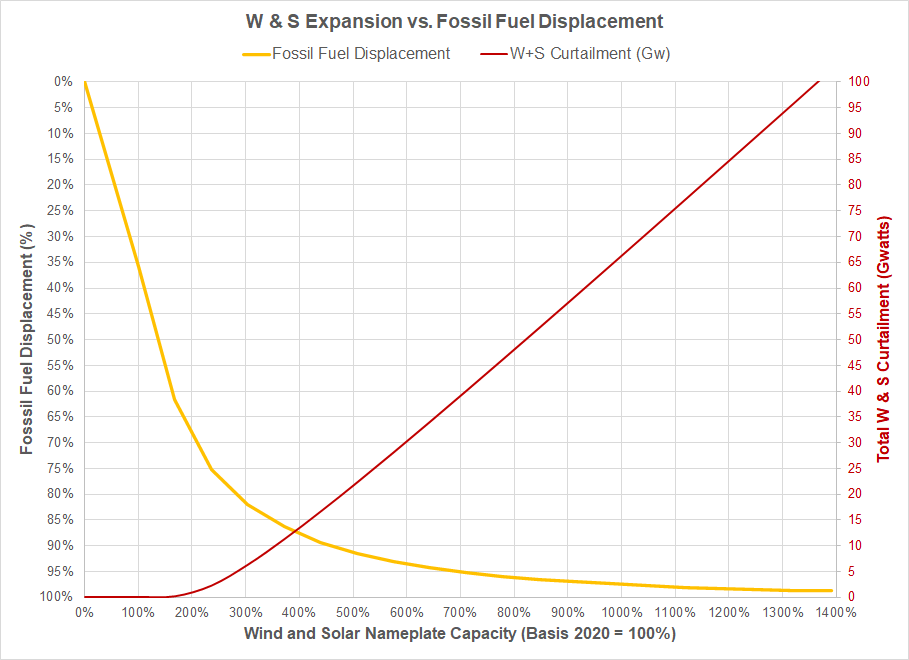
The "Diminishing Returns" phenomena is a result of the high variability, unresponsiveness and unreliability of all Wind and Solar installations
- Being weather dependant and in the case of solar, daylight dependant, total net generation frequently drops to very low values.
- During low generation periods (Point "C") even a 300% increase in W & S capacity is not sufficient to meet demand. To maintain grid stability and to prevent blackout periods, responsive and reliable fossil fuel is critical
- During high generation periods (Point "D") the large capacity of W & S produces more energy than what is required to meet demand. This requires a curtailment of W or S to maintain grid stability including voltage and frequency control. This is the reason that Fossil Fuel Generation and Curtailment co-exist
Energy Storage may be used to absorb a portion of curtailed energy to release when W & S fail to meet demand
- All though it might appear to be simple when looking at the average values above, the high variability of W & S require very large amounts of energy storage to cover periods that can last many days
- At Point "B", 4,000 Mw / 7,500,000 Mwh of storage is required to completely eliminate Fossil Fuels. Even with this amount of storage, 4.1 Gw of curtailment remains
- Battery Storage (93% Eff.) is shown. Due low efficiencies, Hydrogen storage (40%) requires significantly higher capacity
- Other storage technologies such as fly wheels, gravity, air pressure, etc. are not technically viable
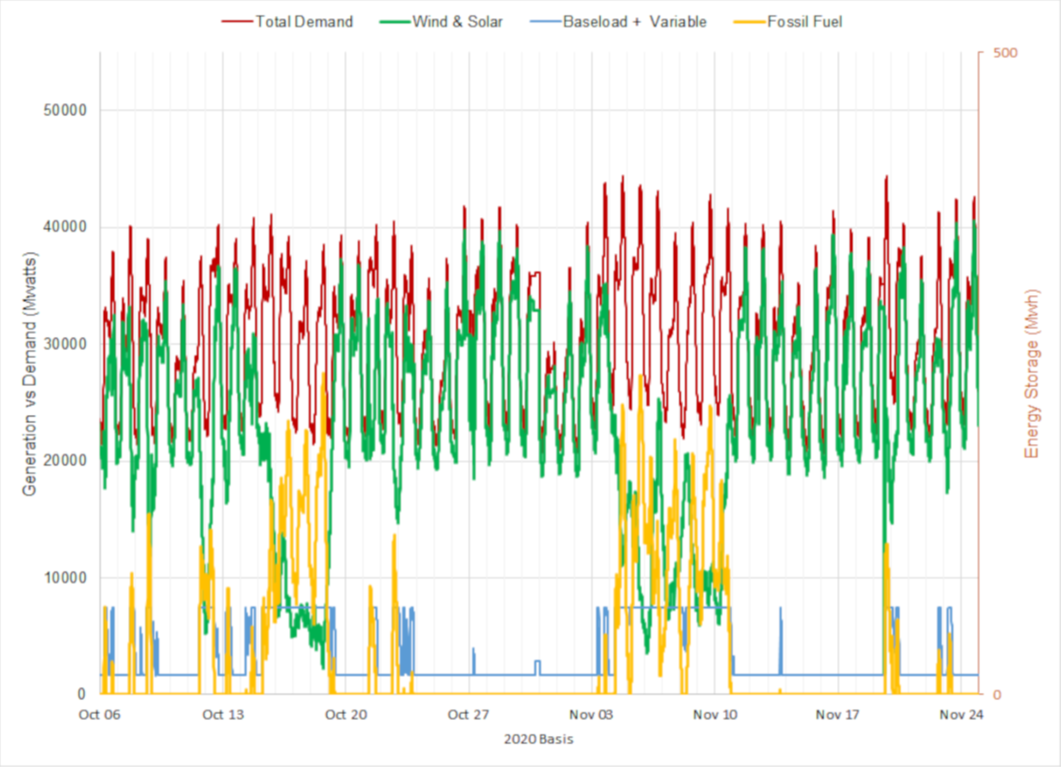
Results modelled using real-time UK wind & solar data from 2020
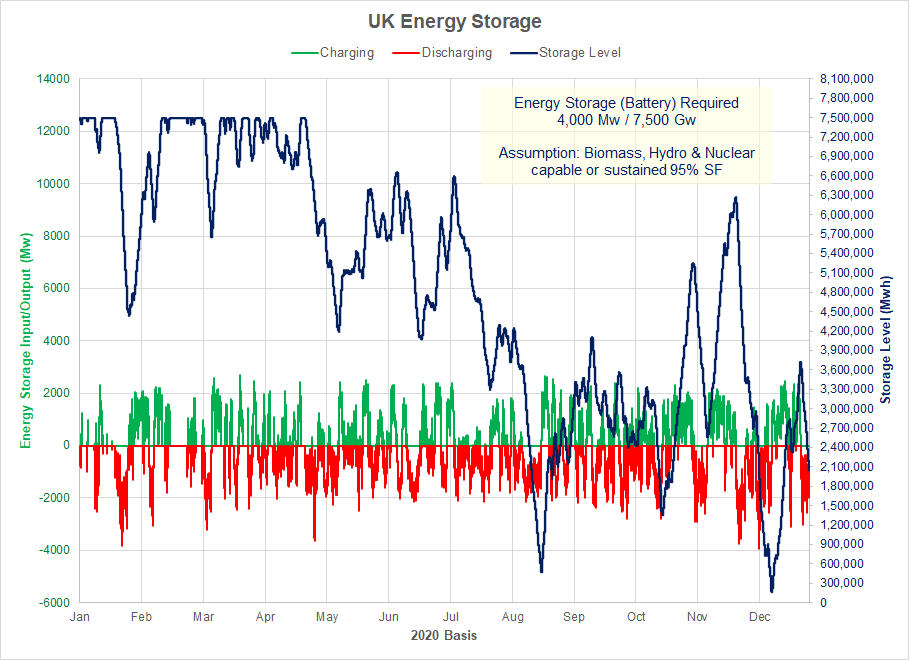
Energy Storage required to displace ALL Fossil Fuel Generation. Full year shown.
The UK Grid has been used for this analysis because of availability of accurate data and global leadership in Wind & Solar adoption.
Source: UK National Grid
Source: DRAX Overview
Source: UK GridwatchTM